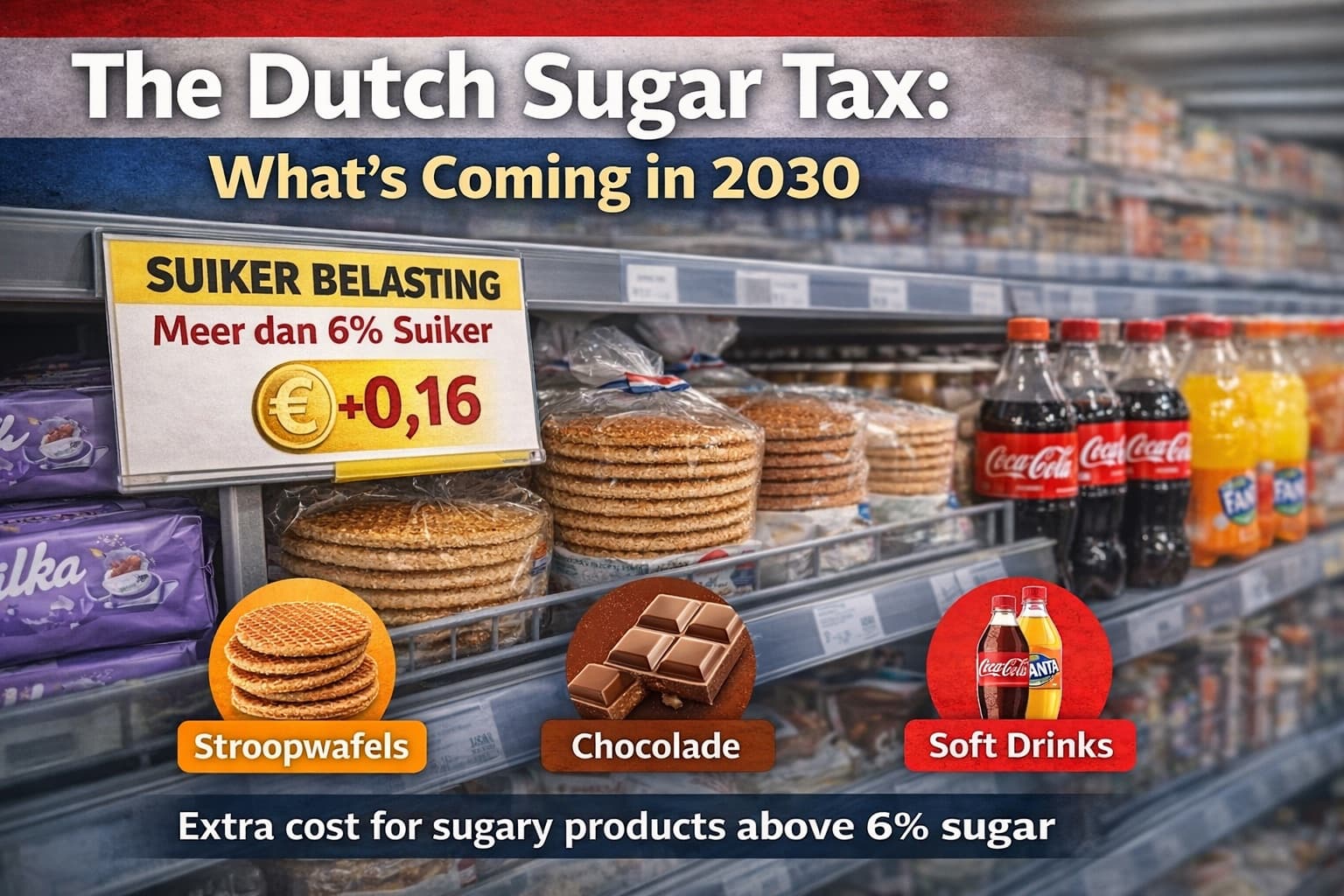
The Dutch sugar tax, or suikertaks, is a planned levy on pre-packaged food and drink containing more than 6% sugar, set to take effect in 2030. Announced in February 2026 as part of the new D66–CDA–VVD coalition agreement, it aims to raise around €850 million per year and nudge Dutch shoppers and manufacturers toward lower-sugar alternatives.
For most households it will mean modest price increases on a specific slice of the weekly shop — and some culturally iconic Dutch products sitting firmly in the crosshairs. Here's what's actually changing, which products are affected, what it's likely to cost, and how to check a product against the new threshold today.
What is the Dutch sugar tax?
The Dutch sugar tax is a proposed extra levy on any pre-packaged food or drink containing more than 6 grams of sugar per 100 grams or 100 millilitres. It is currently proposed as a flat-rate levy — products either cross the threshold or they don't — although Dutch nutrition experts have pushed for a UK-style tiered structure where the rate rises with sugar content. The target effective date is 2030. The government expects it to generate around €850 million per year at full run-rate.
The 6% line is strict. For context:
- A typical cola contains roughly 11g of sugar per 100ml — comfortably over.
- A traditional stroopwafel is above 30% sugar.
- A gevulde koek sits similarly high.
- Most chocolate bars, boiled sweets, and sweet biscuits are well above the line.
Products below 6% — including most bread, savoury snacks, plain yoghurt, and cheese — are not affected.
It only applies to pre-packaged products
The suikertaks will only cover voorverpakt (pre-packaged) food. A stroopwafel from a sealed supermarket pack falls under the rule; the same stroopwafel bought loose from the baker does not. Industry association VBZ has flagged this as a loophole, and the coalition is expected to clarify enforcement ahead of the 2030 start date.
Which products will cost more?
Rabobank estimates that roughly one in five supermarket products will be affected. The clearest examples include:
- Stroopwafels, gevulde koeken, and most Dutch koek — traditional favourites with sugar contents well above 30%.
- Chocolate bars and pralines — typically 40–55% sugar.
- Sweet spreads — chocoladepasta, hagelslag, jam, stroop.
- Candy, drop, and licorice — almost universally above 6%.
- Sweetened breakfast cereals — many children's cereals, sweetened granolas, and muesli clusters.
- Sweetened yoghurts and desserts — fruit yoghurts, vla, toetjes, ijs.
- Sugary soft drinks — though these already carry their own separate tax (see below).
What's likely not affected: plain mineraalwater, plain milk and most dairy, fresh and minimally processed fruit and vegetables, whole grains, and plain nuts.
Drinks already have their own tax
Pre-packaged non-alcoholic drinks in the Netherlands have carried a verbruiksbelasting of €0.26 per litre since January 2024, regardless of sugar content. Mineraalwater was exempted from that tax at the same time on public-health grounds. From 1 January 2027, a separate loophole-closing change kicks in: drinks that add a token amount of milk fat to qualify for the dairy exemption — including some chocolademelk and frambozenmelk formulations — will lose that exemption and face the verbruiksbelasting directly.
This matters for the 2030 debate because policymakers still need to decide how the new sugar levy and the existing drinks tax will fit together — a point industry groups have pushed on repeatedly.
Why is the Netherlands doing this?
The public-health case is straightforward. More than half of Dutch adults and roughly one in eight Dutch children are overweight. The RIVM and consortia like the Alliantie voor de Gezonde Generatie link an estimated 13,000 annual deaths in the Netherlands to poor diet. The Voedingscentrum has supported a sugar tax for years, arguing that making unhealthy food more expensive is one of the most effective population-level levers available.
The government has also stated a budgetary goal (€850–900 million annually) alongside the health goal. That dual purpose has drawn predictable criticism from both sides: public-health advocates say the design prioritises revenue over behaviour change, while industry groups like FNLI and VBZ argue a flat-rate food tax is a blunt instrument compared with reformulation incentives.
Does a sugar tax actually work?
The international evidence is reasonably strong for drinks and thinner for solid food.
- United Kingdom (2018): a tiered soft-drinks levy drove manufacturers to reformulate aggressively. Sugar volumes sold through drinks fell by roughly 30% within three years — an effect visible across all income groups.
- Mexico (2014): a flat per-litre drinks tax produced clear reductions in sugary-drinks purchases, especially among lower-income households.
- Poland (2021): a hybrid design combining a fixed fee and a per-gram surcharge; measurable decline in sugary-drinks sales.
- Denmark abolished its broader sugar tax in 2013 after concluding it drove cross-border shopping into Germany with limited domestic health benefit.
For solid food specifically, the evidence is thinner. The Dutch chocolate market is a useful stress test: over the past five years, chocolate prices rose by around 50%, while volumes fell only about 10%. That's a very inelastic demand curve — shoppers largely absorb the price increase. Critics of the Dutch flat-rate design argue a tiered UK-style structure would push manufacturers to reformulate rather than simply pass costs on.
How much will the sugar tax cost the average Dutch person?
Around €50 per person per year, on average — based on government revenue projections divided across roughly 18 million people. That headline figure hides a wide distribution. Households that rarely buy sweets and sugary drinks will pay close to zero in practice, while heavy consumers can expect considerably more.
Rabobank's modelling, which assumes supermarkets pass the tax through fully, suggests individual affected products could see prices rise by 10–20% or more, depending on sugar content and margin policy.
How to check a product's sugar content today
You don't have to wait until 2030 to see where your regular shop would stand. Sugar content is already printed on the nutrition label of every pre-packaged product sold in the Netherlands, expressed in grams per 100g or per 100ml. Anything above 6 crosses the line.
Faster than reading every label: scan the barcode. Tools like Nime read the product's full nutrition panel and ingredient list, flagging sugar content alongside additives, sweeteners, and allergens. For Dutch shoppers specifically, that lets you:
- Quickly compare two products side by side in the aisle.
- See sugar and everything else — additives, palm oil, non-sugar sweeteners — in a single scan.
- Spot reformulated versions as manufacturers start adjusting recipes ahead of 2030.
Because the 6% line is a regulatory threshold rather than a nutritional cliff, an app-level view tends to be more useful than a simple yes/no tax label: 7% sugar is barely different from 6% in dietary terms, but only one will be taxed.
Frequently Asked Questions
When does the Dutch sugar tax start?
The Dutch sugar tax is scheduled to take effect in 2030. The 2026 coalition agreement confirms the intention; the implementing legislation and exact rates will be drafted by the Ministry of Finance in the coming years.
Which products will be taxed?
Pre-packaged food and drink containing more than 6 grams of sugar per 100 grams or 100 millilitres. In practical terms: most sweets, chocolate, biscuits, stroopwafels, gevulde koeken, sweet spreads, many cereals, sweetened yoghurts, and sugary soft drinks. Plain dairy, fresh produce, most bread, and savoury snacks are not affected.
Is the Dutch sugar tax the same as the verbruiksbelasting on soft drinks?
No. The verbruiksbelasting is a flat €0.26 per litre already applied to non-alcoholic drinks since January 2024, regardless of sugar content. The 2030 suikertaks is a separate levy aimed at sugar specifically and will cover solid food as well as drinks. How the two will interact is part of what still needs to be worked out.
Will a sugar tax actually make people healthier?
The strongest evidence comes from tiered drinks taxes — most clearly the UK's — where the structure pushed manufacturers to reformulate. Flat-rate taxes and taxes on solid food have weaker track records, because demand for products like chocolate is relatively inelastic and reformulating solid food is harder than reformulating drinks.
How can I check if a product is above 6% sugar?
Read the nutrition label. Sugar in grams per 100g (or per 100ml for drinks) is printed on every pre-packaged product sold in the Netherlands. Anything above 6g crosses the line. A food scanner app like Nime reads this automatically from the barcode and can also flag the things sugar alone doesn't tell you — artificial sweeteners, additives, and palm oil.
Sources: Dutch coalition agreement, February 2026; NOS, Voeding Nu, EW, Rabobank (RaboResearch), Rijksoverheid.nl; RIVM; Voedingscentrum; Alliantie voor de Gezonde Generatie.