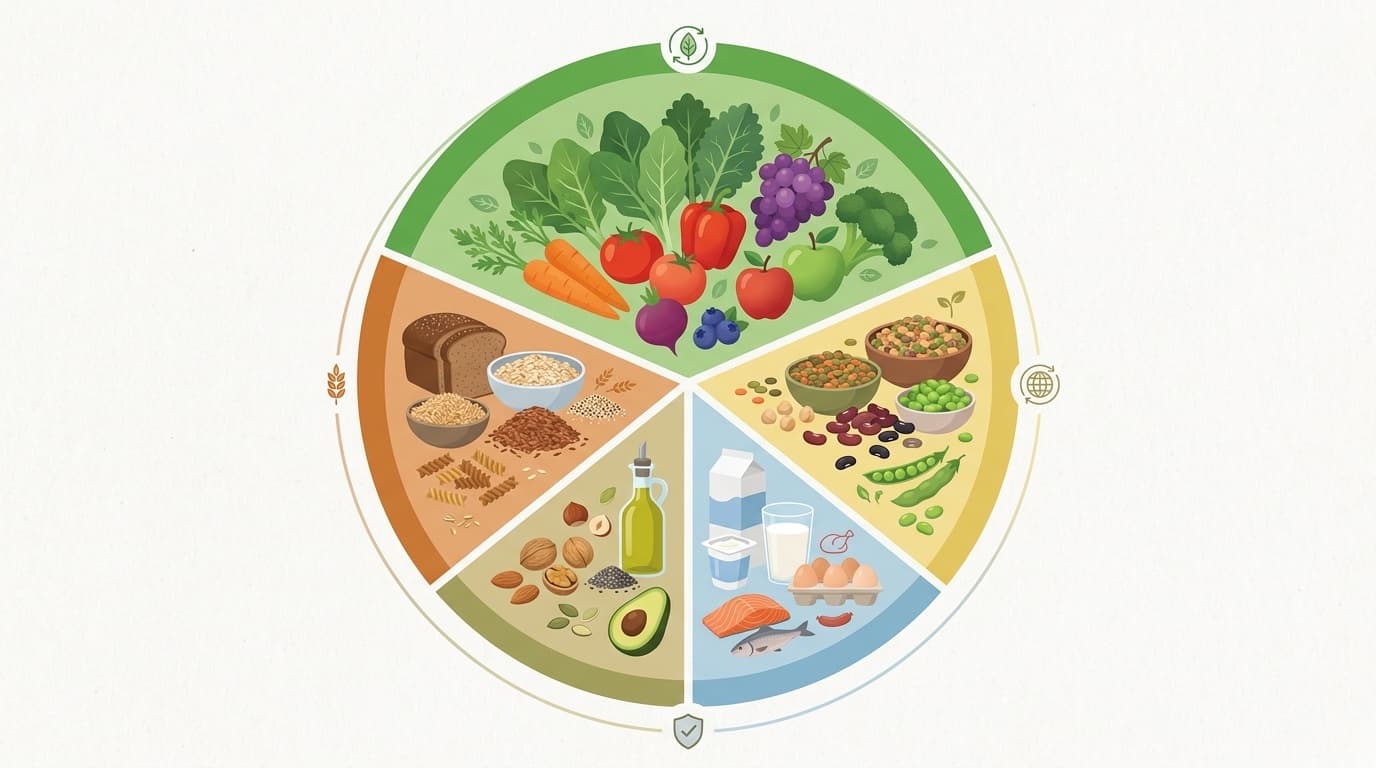
The new Schijf van Vijf launched on 9 April 2026 — the biggest update in years to the Netherlands' core dietary model. The headline changes: a sharp cut in the weekly red-meat recommendation, a bigger role for peulvruchten and nuts, and — for the first time ever — food safety is built into the framework alongside health and sustainability.
The familiar five-compartment wheel hasn't disappeared. The numbers inside it have. Here's what actually changed, why, and how to tell whether your regular weekly shop still fits the updated model.
What is the Schijf van Vijf?
The Schijf van Vijf is the Voedingscentrum's official guidance model for healthy, sustainable, and safe eating in the Netherlands. Five categories — groente & fruit; brood & granen; zuivel & vleesvervangers; vis, vlees, ei & peulvruchten; vetten & oliën — together describe what a balanced Dutch diet looks like across a week.
The 2026 edition is the first full revision in years. It translates the Gezondheidsraad's updated Richtlijnen goede voeding — published across 2024 and 2025, with the most consequential revisions covering protein sources — into practical daily and weekly advice. According to Voedingscentrum director Petra Verhoef, the new Schijf is the first national dietary model anywhere to formally combine health, sustainability, and food safety in a single framework.
What changed in the 2026 update?
Four things matter most. The structure of the five vakken stays the same; the content inside them has shifted toward plants.
Red meat is cut by roughly two-thirds
This is the biggest change. Under the previous Schijf van Vijf, adult men could eat up to 500g of meat per week, of which up to 300g could be red meat. The new model drops the total to 300g per week, with no more than 100g red meat. Processed meat (worst, ham, spek, salami, rookvlees) should stay as low as possible — the evidence linking it to colorectal cancer is considered firmly established.
For most Dutch households this is a significant adjustment. Average current intake sits well above the new cap.
Peulvruchten and nuts move into the spotlight
The updated Schijf explicitly promotes weekly peulvruchten — linzen, kikkererwten, bruine bonen, witte bonen, kapucijners, spliterwten — as a direct substitute for part of the animal-protein share. A daily handful of unsalted nuts is also part of the new standard recommendation, up from a weaker mention in the previous version.
The intent is simple: when red meat comes down, something has to take its place in the protein column. Peulvruchten and nuts are the headline answer.
Food safety is now built into the model
New for 2026: the Voedingscentrum has added voedselveiligheid as an explicit criterion alongside nutrition and sustainability. In practice that means products flagged for heavy-metals contamination, pesticide residues, or concerning additive profiles can be excluded from the "binnen de Schijf" recommendation even when they look fine on nutrients alone.
This brings the Schijf closer to how a food-scanner app already thinks about a product — as a combination of what's nutritious and what's actually safe to eat in regular quantities.
Sustainability carries equal weight
Previous versions of the Schijf treated sustainability as context. The 2026 edition gives it parity with health. Imported products with high transport emissions or intensive pesticide use in origin countries can fall outside the recommendation. Local, seasonally appropriate plant foods are pushed forward.
How do you actually eat according to the new Schijf van Vijf?
A simple daily picture, based on the updated advice:
- 250g vegetables, 200g fruit — both unchanged from the previous Schijf.
- Whole-grain bread and grains as the base for bread, rice, and pasta choices.
- One serving of fish per week (1–2 for people with cardiovascular disease); max 300g meat per week for adult men, max 100g of which is red meat.
- Weekly peulvruchten, with a stronger default frequency than the old model's "1× per week".
- A daily handful of unsalted nuts.
- Olive oil and other soft, unsaturated fats for cooking; hard fats like roomboter moved firmly into the "limit" column.
- Dairy remains in the Schijf, with more flexibility to swap in plant-based alternatives than the previous version allowed.
A helpful reframe from the Voedingscentrum: if you already eat no more than 500g of meat per week and keep dairy modest, you're probably already at a roughly 50/50 plant-to-animal ratio. The 2026 Schijf nudges that closer to 60/40 plant-forward.
Why did the Schijf van Vijf change now?
Three pressures converged.
First, the Gezondheidsraad updated its Richtlijnen goede voeding with stronger recommendations on plant proteins, concluding — in line with its 2023 eiwittransitie advice — that a more plant-based pattern is better both for health and for the planet.
Second, the underlying health picture in the Netherlands remains difficult. More than half of Dutch adults and roughly one in eight Dutch children are overweight. An estimated 13,000 deaths per year in the Netherlands are linked to poor diet, according to figures cited by the Alliantie voor de Gezonde Generatie.
Third, food safety has become harder to treat as background. Regulators and consumer groups are paying closer attention to pesticide residues on imports, controversial additives working their way through EFSA re-evaluations, and — separately — heavy-metals exposure in specific product categories. Folding that into the Schijf means the model now reflects how many Dutch shoppers already think when they read a label.
How to check if your products fit the new Schijf van Vijf
Three practical ways to tell:
- Read the nutrition panel and ingredient list. The Schijf's broad rules — whole-grain, modest salt, moderate saturated fat, limited added sugar — are all visible on the pack if you know what to look for.
- Scan the barcode. A food scanner app like Nime reads the full ingredient list and nutrition data in seconds, flags additives and sweeteners that the Schijf now explicitly cares about, and surfaces sugar, saturated-fat, and salt levels against reference amounts.
- Compare two products side by side. The shift toward plant-forward eating doesn't mean every "plant-based" product on the shelf is actually healthier — many plant-based ready meals are highly processed. A scanner lets you see whether the alternative really is better, or just better-marketed.
Where a scanner earns its keep is on the things the Schijf cares about but the front of pack usually doesn't spell out: food-additive density, non-sugar sweetener load, palm oil, and whether a "plantaardig" alternative is actually lower in salt and saturated fat than the meat version it's replacing.
Frequently Asked Questions
When did the new Schijf van Vijf launch?
The Voedingscentrum launched the updated Schijf van Vijf on 9 April 2026. The previous version remains usable as a general guide — the five categories and most day-to-day advice have not changed — but the specific amounts and emphasis have.
What's the single biggest change in the 2026 Schijf van Vijf?
The cut in recommended red meat. The weekly cap for adult men drops from 300g to 100g of red meat, and total meat from 500g to 300g. Everything else in the update flows from that shift — more peulvruchten, more nuts, and more flexibility to swap dairy for plant-based alternatives.
Does the new Schijf van Vijf mean I have to become vegetarian?
No. The Schijf van Vijf is not a diet and is not plant-only. It sets a framework where roughly 60% of your protein and calories come from plant sources and 40% from animal sources, rather than the reverse. Red meat, fish, eggs, and dairy all remain inside the Schijf — just at lower volumes than many Dutch shoppers are used to.
How is the Schijf van Vijf different from Nutri-Score?
They answer different questions. Nutri-Score rates a single product's nutritional profile on an A-to-E scale relative to its category. The Schijf van Vijf is a pattern — what a healthy and sustainable week of eating looks like across categories. You use Nutri-Score (or a scanner app) in the shop for a specific product; you use the Schijf to check whether your overall weekly mix is in balance.
How do I shop according to the new Schijf van Vijf without spending hours reading labels?
Fastest route: scan. A food scanner app like Nime shows nutrition, ingredients, additives, and sweeteners in a couple of seconds per product — which is about as close as you can get to applying the Schijf's combined health-sustainability-safety lens in real time at the supermarket.
Sources: Voedingscentrum, press release and updated materials, 9 April 2026; Gezondheidsraad, Richtlijnen goede voeding: eiwitbronnen en voedingspatronen 2024–2025; Hart van Nederland, 9 April 2026; L1 Nieuws, 11 March 2026; Alliantie voor de Gezonde Generatie; Nederlandse Vereniging van Diëtisten (NVD).